
Screen Time in 2025: Patterns, Boundaries, and Balance

As the year comes to an end, it’s a good time to pause and take stock, not just of grades and milestones, but of how our children have navigated the digital world. Screens have been a constant companion this year, for learning, play, and connection. The real question isn’t whether our kids used screens, but how well they were managed. Looking back at a year of data from devices with Mobicip installed offers a grounded way to reflect on what worked, what changed, and what healthy digital habits can look like in real family life.
Putting Our Data in Perspective
Public data on children’s screen habits paints a worrying picture. According to Statista data interpreted by DemandSage, 74% of American parents report that their two-year-old watches television, and children in the United States spend an average of 1 hour and 53 minutes per day on TikTok alone. These figures suggest that screen exposure begins early and escalates rapidly, often long before children can self-regulate their digital behaviour.
At Mobicip, we have noticed clear patterns emerging from a year of anonymized usage data collected from devices running Mobicip. While this data does not capture all forms of screen exposure – children may still use shared family televisions or unmanaged devices – it offers a meaningful view of what happens when parents actively monitor, limit, and guide their children’s digital use on their personal devices.
About the Data on Screen Time in 2025
- This report is based on anonymized, aggregated screen-time data from Mobicip-managed devices collected across 2025.
- Data reflects average daily screen time by age, measured in minutes.
- Only activity on devices with Mobicip installed is included.
- No personally identifiable information was collected or analyzed.
- The data does not claim to represent total screen exposure, but rather screen use under active parental management.
Age-Wise Screen Time Patterns
Here’s the snapshot of our observation:
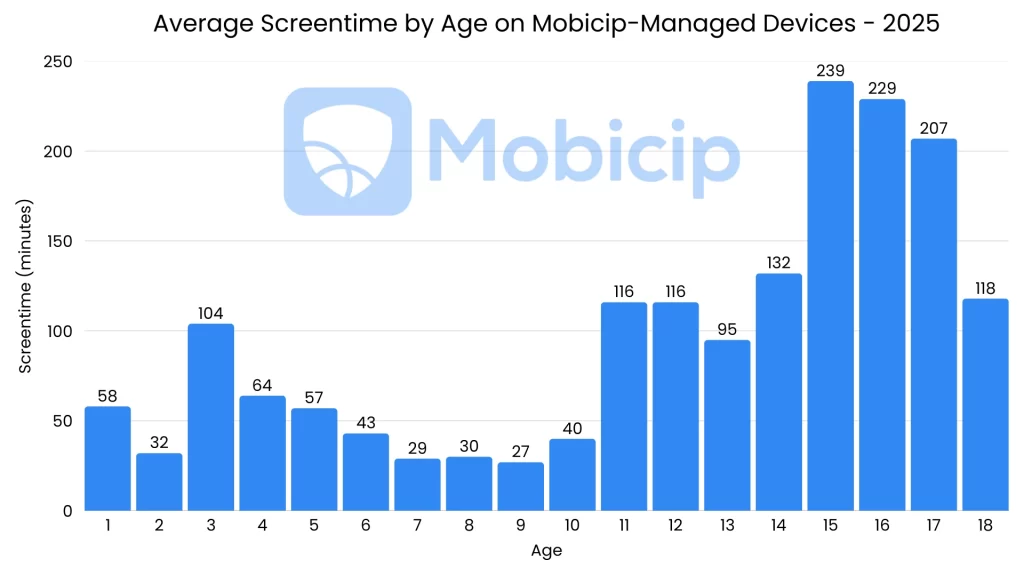
Early Childhood (Ages 1–5): Limited but Uneven Exposure
In early childhood, average daily screen time remains relatively low, ranging from 32 to 104 minutes. Most ages fall within an hour, with age three showing the highest average.
This variability likely reflects situational use, such as screens used during travel, illness, or moments when caregivers need support, rather than habitual or unrestricted access. Notably, even the higher values remain below national averages, indicating near-daily screen exposure starting in toddlerhood.
The data suggests that when parents actively manage devices, screens are used selectively and intentionally in the early years, rather than as a default activity.
Middle Childhood (Ages 6–10): The Most Balanced Phase
Between ages six and ten, screen time drops further and stabilizes, clustering between 27 and 43 minutes per day. This is the lowest and most consistent period of screen use in the dataset.
These years often coincide with structured school routines, more explicit household rules, and limited ownership of personal devices. With monitoring tools in place, screens appear to supplement daily life rather than compete with it.
This phase highlights a key insight: healthy digital habits are easiest to sustain when boundaries are set early and reinforced consistently.
The Transition Years (Ages 11–13): A Critical Shift
A clear inflection point occurs at ages 11 and 12, when average daily screen time rises sharply to 116 minutes (nearly 2 h), and remains elevated at age 13.
This stage often marks the introduction of personal smartphones, increased online homework and gaming, and early exposure to social media. Even with parental controls, children’s digital independence expands rapidly during these years.
The data identifies ages 11 to 13 as a crucial intervention window. Families that revisit rules, adjust limits, and deepen conversations around digital responsibility during this phase may prevent steeper increases later.
Adolescence (Ages 14–17): Rising Use, Still Moderated
From age 14 onward, screen time increases significantly:
- Age 14: 132 minutes (>2 h)
- Ages 15–17: 207 to 239 minutes per day (>3.5 h)
This rise reflects broader adolescent realities, constant communication, streaming, gaming, academic demands, and social media engagement. However, even at its peak, screen use on Mobicip-managed devices remains lower than widely reported national averages, which often cite 7 to 9 hours of daily screen exposure for teens.
This suggests that parental monitoring does not eliminate increased screen use during adolescence, but it helps contain and structure it.
Age 18: A Meaningful Decline
At age 18, average screen time drops to 118 minutes (~2 h) per day. This decline may reflect exam preparation, shifting priorities, or a growing focus on offline responsibilities.
It also hints at a longer-term effect: early boundaries and guided habits may continue to influence behaviour, even as parental oversight naturally loosens.
How Screen Time Changed Through the Year
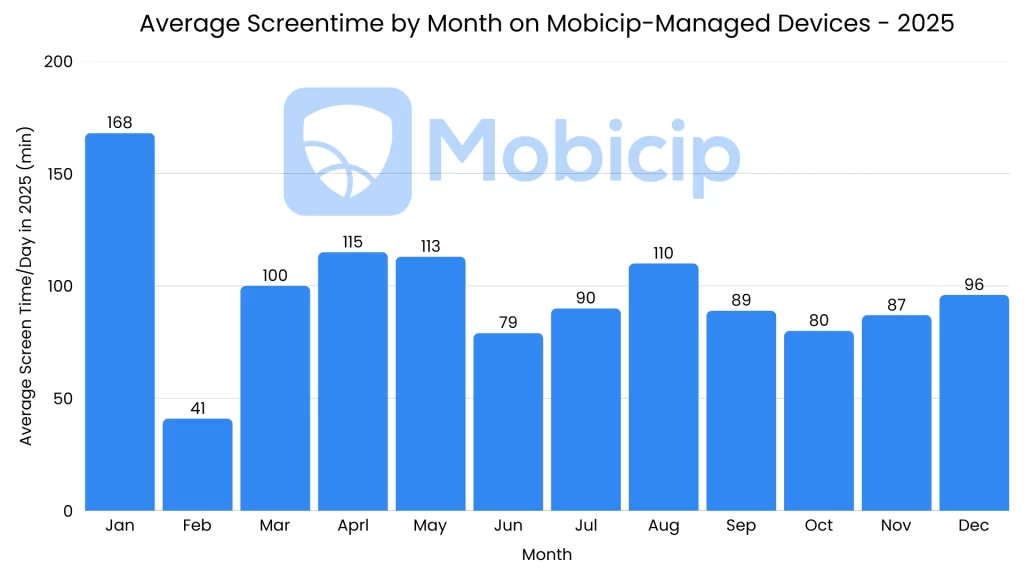
When we looked at Screen Time in 2025 from devices with Mobicip installed, one thing stood out clearly: screen use rises and falls with family routines, and parents continue to step in, even during holidays.
- At the start of the year, screen time is at its highest. January tends to be an extension of the holiday season, with looser schedules, more time at home, and fewer structured activities. It’s natural for screens to fill some of that gap. What matters is what happens next.
- By February, screen time drops sharply. This suggests that once school resumes, many parents actively reset rules and routines. Limits are re-established, and screen use quickly returns to control.
- As the year settles into a rhythm between March and May, screen time finds a steady middle ground. Screens are used for schoolwork, entertainment, and staying connected, but they don’t dominate the day. This is what balanced use often looks like in real life, not perfect, but predictable.
- One of the most reassuring findings appears during the summer months. Even when school is out, screen time does not spike dramatically. This suggests that parents who use Mobicip continue to set boundaries rather than granting unlimited access during holidays. There is flexibility, but structure remains.
- The same pattern shows up toward the end of the year. Screen time rises slightly in November and December as routines loosen again and families spend more time indoors. But the increase is modest. Unlike the sharp jump seen at the beginning of the year, year-end screen use stays within limits, showing that parents remain engaged even during festive breaks.
Overall, this data tells an encouraging story. When parents stay involved and maintain control, screen time doesn’t spiral out of control. It bends with the season, but it doesn’t break.
Key Insights from Managed Screen Use
Screen time patterns change when parents stay actively involved. Screen Time in 2025 from devices with Mobicip installed shows that screen use is not random or runaway. It responds quickly to routines, rules, and parental guidance.
Early screen exposure does not have to be constant or excessive.
In early childhood, screen use remains limited and uneven, showing that caregivers use screens intentionally for specific situations rather than as a default activity.
Middle childhood is the most balanced phase for screen use.
Between ages 6 and 10, screen time is at its lowest and most consistent. This is when early boundaries, clear rules, and supervision have the most substantial effect.
Ages 11–13 are a critical turning point.
Screen time rises sharply during the pre-teen years as personal devices, online schoolwork, and social platforms come into play. This is the most important window for parents to reset expectations and reinforce healthy habits.
Teen screen use increases, but it can still be managed.
During adolescence, screen time rises significantly, but on Mobicip-managed devices, it remains lower than widely reported national averages. Monitoring helps contain and structure use rather than eliminate it.
Early boundaries appear to have lasting effects.
The drop in screen time at age 18 suggests that habits shaped earlier continue to influence behaviour, even as parental oversight naturally loosens.
Screen use rises during holidays and breaks, especially in January and December, but drops quickly when routines return. Parents continue to moderate use even during school holidays.
Consistency matters more than perfection.
Screen time ebbs and flows with seasons, school schedules, and life events, but it does not spiral out of control when parents stay engaged and keep controls in place.

Conclusion
Moments of transition invite reflection. As one year closes and another begins, families often pause to consider what is worth carrying forward and what needs adjustment. Screen habits are no different. They are shaped not by dramatic overhauls, but by small, repeated choices made across ordinary days.
This analysis of Screen Time in 2025 shows that active parental involvement provides continuity amid change. As children grow older, gain independence, and face new digital demands, consistent guidance helps screen use remain purposeful rather than overwhelming. Boundaries may shift, but they do not disappear.
Looking ahead, the focus need not be on stricter limits or perfect balance, but on staying attentive, observing what works, responding when patterns drift, and making course corrections when needed. When screen use is managed with intention, families enter the year ahead not with anxiety about technology, but with confidence in their ability to navigate it together.