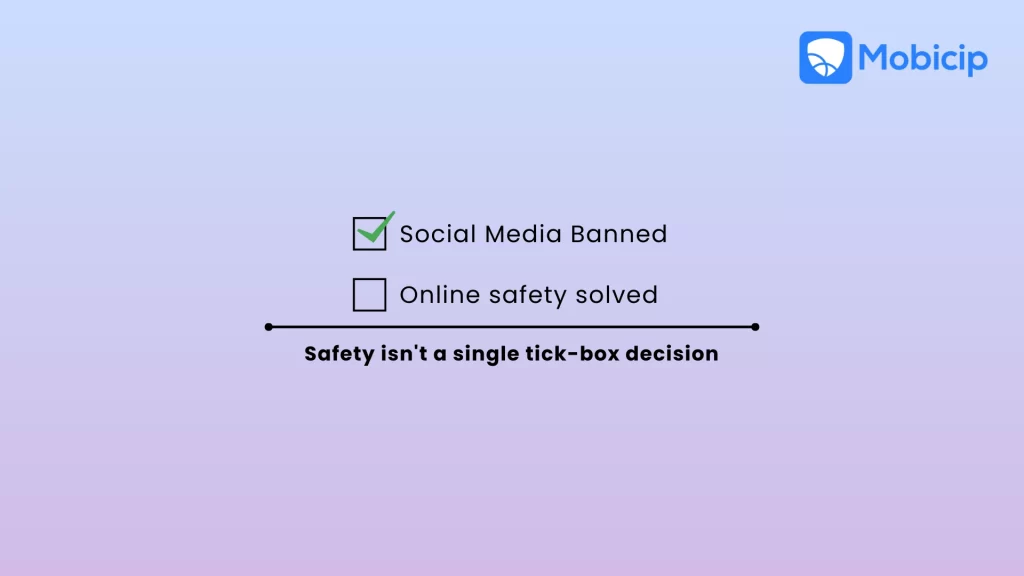
Why Social Media Restrictions are Not Enough to Protect Kids Online

As governments around the world consider stricter rules for children’s social media use, many parents are asking an important question: will restricting access to social media really keep kids safe online?
While age-based restrictions may help reduce children’s exposure to some risks, social media is only one part of their digital lives. Kids today spend time on gaming platforms, messaging apps, video-sharing sites, and emerging technologies that present many of the same challenges.
Protecting children online requires more than limiting access to specific apps or platforms. It means helping them develop healthy digital habits, teaching them how to recognize and respond to online risks, and creating an environment where they feel comfortable talking about their experiences.
In this article, we’ll explore why social media restrictions alone cannot address every online risk children face and how parents can build a more comprehensive approach to digital safety through ongoing conversations, digital literacy, and tools such as Mobicip.
How Different Countries Are Approaching Social Media Restrictions for Kids
Concerns about children’s online safety are driving governments around the world to rethink how young people access social media. While approaches vary, many countries are exploring age-based restrictions, stronger platform accountability, and new requirements for age verification.
Australia has taken the most far-reaching approach so far. Since December 2025, major social media platforms have been required to take reasonable steps to prevent children under 16 from creating or maintaining accounts. The law places responsibility on platforms—not parents—to enforce age restrictions.
In France, children under 15 need parental consent to create social media accounts, while other European countries, including Denmark, Greece, and Spain, are considering similar measures. The European Union is also exploring broader regulations aimed at reducing addictive platform features and strengthening protections for young users.
The United Kingdom is moving toward stricter rules inspired by Australia’s model, with proposals that would restrict social media access for users under 16 and place greater responsibility on technology companies to protect children from harmful content.
In the United States, there is no nationwide social media ban, but several states have introduced laws requiring age verification and parental consent for minors. States such as Utah and Ohio have adopted measures that increase parental oversight and require platforms to verify users’ ages.
Despite these differences, one challenge remains consistent across countries: enforcement. Age verification systems raise questions about privacy, accuracy, and effectiveness, while many children find ways to bypass restrictions by using alternate accounts, borrowing devices, or migrating to other platforms. Early experiences suggest that regulations can be an important part of online safety, but they work best when combined with digital literacy, parental involvement, and tools that help families navigate children’s broader digital lives.
Online Risks Don’t End With Social Media
Restricting access to social media platforms may reduce children’s exposure to certain online risks, but it doesn’t eliminate the challenges they face in today’s connected world. Children move seamlessly between gaming platforms, messaging apps, video-sharing sites, web browsers, and emerging technologies, often interacting with the same people and content across multiple digital spaces.
As a result, limiting access to one category of apps can leave many other risks unaddressed. In some cases, children may simply shift their online activity to platforms that receive less parental attention or have fewer safety features.
Even without social media accounts, children can still encounter:
- Cyberbullying and harassment through group chats, gaming communities, and messaging apps
- Inappropriate or harmful content on video-sharing platforms, forums, and websites
- Contact with strangers or online predators through multiplayer games and anonymous communities
- Scams, phishing attempts, and misinformation designed to exploit young users
- Excessive screen time and unhealthy digital habits across multiple devices and apps
- Privacy and data security risks, including oversharing personal information online
Children are also highly adaptable technology users. Many can bypass age restrictions by entering inaccurate birth dates, borrowing devices from friends, creating alternate accounts, or migrating to newer platforms that offer similar experiences.
This doesn’t mean age-based restrictions have no value. They can be an important part of a broader online safety strategy. But lasting protection comes from a combination of parental involvement, digital literacy, open communication, and tools that help families guide children’s online experiences across all the digital spaces they use.
How Parental Controls Help Protect Kids Across the Digital World
A social media control focuses on restricting access to specific platforms. Parental controls take a broader, more practical approach by helping families manage children’s entire digital environment. Most importantly, parental controls can evolve alongside a child’s age, maturity level, and online habits, creating a more balanced approach to digital safety. Here are some ways in which parental control apps and software can help.
Provide Protection Across Multiple Online Platforms
Children’s digital lives extend far beyond social networking apps. They watch videos, play online games, communicate through messaging services, complete schoolwork online, and browse the web.
Comprehensive parental controls help protect children across these different environments by enabling parents to:
- Filter inappropriate websites and search results
- Block or limit access to specific apps and games
- Monitor activity across multiple devices
- Manage access to messaging and video-sharing platforms
- Receive alerts about potential online risks
This broader coverage helps close the safety gaps that a social media ban cannot address.
Encourage Healthy Screen Time Habits
Restricting social media access does not automatically reduce overall screen time. Children may simply shift their attention to gaming apps, streaming services, or web browsing.
Parental controls help families establish healthier routines by allowing parents to:
- Set daily screen time limits
- Schedule device-free periods for homework, sleep, and family time
- Create app-specific time limits
- Pause internet access when needed
- Encourage balanced use of technology
Over time, these boundaries help children develop self-regulation skills and healthier digital habits.
Offer Age-Appropriate Guidance
Children’s online needs change significantly as they grow. A one-size-fits-all restriction may not be suitable for every age group.
Parental controls allow families to adjust safety settings based on factors such as:
- A child’s age and maturity level
- Their level of digital responsibility
- Educational and extracurricular needs
- Specific concerns related to online behavior
As children demonstrate responsible technology use, parents can gradually increase independence while maintaining appropriate safeguards.
Help Parents Identify Risks Early
Many online safety issues develop gradually and may not be immediately obvious.
Parental control tools can help parents spot warning signs before problems escalate, including:
- Sudden increases in screen time
- Access to risky or age-inappropriate content
- Attempts to bypass restrictions
- Downloads of unfamiliar apps
- Changes in online behavior patterns
Early awareness gives parents an opportunity to start supportive conversations and address concerns proactively.
Support Open Communication Instead of Surveillance
The goal of parental controls is not to monitor every action a child takes online. Effective digital parenting combines technology with trust, communication, and education.
Parents can use parental controls as a starting point for conversations about:
- Online privacy and personal information
- Respectful digital communication
- Recognizing scams and misinformation
- Responding to cyberbullying
- Building healthy technology habits
When children understand that safety tools are designed to support and not punish them, they are more likely to develop responsible online behaviors.
Adapt to New Platforms and Emerging Risks
Digital trends change quickly. New apps, games, and online communities appear faster than regulations can keep pace.
Parental controls offer greater flexibility because they can adapt to changing online habits and emerging risks. Instead of focusing on a fixed list of social media platforms, parents can respond to new technologies as their children begin using them.
Solutions such as Mobicip provide families with customizable tools for screen time management, content filtering, app blocking, and activity monitoring across multiple devices, helping parents create a safer online experience that extends well beyond a social media ban.
How Mobicip Complements Social Media Restrictions
Designed to support healthy technology use across multiple devices, Mobicip helps parents create age-appropriate digital boundaries while encouraging open conversations about online safety. Instead of focusing solely on social media, it provides tools to manage children’s entire online experience.
With Mobicip, parents can:
- Filter inappropriate websites and content across browsers and search engines
- Block or limit specific apps and games based on a child’s age and needs
- Set daily screen time limits and create personalized schedules
- Pause internet access instantly during homework, bedtime, or family activities
- Monitor app usage and online activity across devices
- Receive alerts about potential risks and attempts to bypass restrictions
- Manage multiple devices from a single dashboard, making it easier to oversee family technology use
Mobicip’s flexible settings allow parents to gradually adjust restrictions as children mature and demonstrate responsible online behavior. This helps families strike a balance between protecting children and giving them the independence they need to develop healthy digital habits.

FAQs
Are social media restrictions enough to keep kids safe online?
No. While restricting access to social media can reduce exposure to certain risks, children also spend time on gaming platforms, messaging apps, video-sharing sites, and other digital spaces. A comprehensive approach to online safety includes parental involvement, digital literacy, open communication, and age-appropriate parental controls.
Is Australia banning social media for kids completely?
No. The proposed rules focus on restricting access to certain social media platforms for users under 16. Children will still be able to access other online services, such as educational websites, messaging tools, gaming platforms, and video content.
What does the UK Online Safety Act say about children and social media?
The UK Online Safety Act requires online platforms to assess and reduce risks to children, implement age-appropriate protections, and remove harmful content more effectively. It focuses on platform accountability rather than introducing a blanket social media ban.
Does a government-issued social media ban improve kids’ online safety?
A social media ban may reduce exposure to some online risks, but it cannot eliminate them entirely. Children can still encounter harmful content and unsafe interactions through other digital channels.
Why aren’t social media restrictions a fool-proof solution for kids’ online safety?
Online risks extend beyond social media platforms. Children may use messaging apps, gaming services, forums, or other websites where similar risks exist, and some may find ways to bypass restrictions.
How can a parental control app help where social media restrictions fall short?
Parental control apps provide broader protection by helping parents manage screen time, monitor online activity, block inappropriate content, and receive alerts about potential risks across multiple apps and devices.
What works better for kids: a social media ban or parental controls?
The most effective approach combines both. Age-based restrictions can reduce access to certain platforms, while parental controls provide ongoing supervision and help children develop healthy digital habits over time.
Take Away
Keeping kids safe online isn’t about choosing between unrestricted access and strict limitations. It’s about giving children the skills, guidance, and support they need to navigate an increasingly complex digital world with confidence.
As online experiences expand beyond social media to include gaming platforms, messaging apps, video-sharing sites, and emerging technologies, parents need strategies that evolve alongside them. Age restrictions and regulations can provide important guardrails, but they cannot replace ongoing conversations, digital literacy, and healthy family boundaries.
By combining thoughtful policies with proactive tools like Mobicip, families can create a stronger foundation for safer, smarter, and more positive digital experiences.