AI-Powered Homework Tools: Are They Helping Kids Learn or Just Helping Them Finish?
AI-powered homework tools are artificial intelligence systems that help students complete assignments by generating explanations, summaries, essays, or problem solutions. While these tools can support learning when used responsibly, overreliance may weaken critical thinking and problem-solving skills if students depend on AI to complete work instead of understanding it.
From chatbots that generate essays to math solvers that go beyond the simple calculations of the humble calculator, AI-powered homework tools are being increasingly used by students these days. It’s not hard to see why – these tools are speedy and convenient. They offer seemingly maximum-reward for minimum effort.
While AI homework tools can be helpful when used in moderation, an important question looms: when does assisted learning turn into a shortcut?
As these tools rise in popularity, it is important for parents to understand the ways in which they work, and the ways in which they don’t. While AI algorithms can be used to enhance and augment learning, they can also act as an easy shortcut that hampers students’ logical and critical thinking abilities. Over-reliance on these tools can render the whole point of education moot.
In this article, we will explore the benefits and harms of AI-powered homework and help parents understand where to draw the line. We will also share practical strategies for parents and educators to promote the healthy and productive use of these technologies through open communication, reasonable boundaries, and tools such as Mobicip.

What Is AI-Powered Homework?
AI-powered homework refers to the use of artificial intelligence tools to assist students with school assignments and academic tasks. These tools can help with writing, problem solving, research, and studying by generating explanations, summaries, or answers based on user prompts. Today, there are many different types of AI-powered homework tools used by students.
Chatbots and Writing Assistants
Recently, the popular online learning platform Khan Academy, released Khanmigo, an AI powered chatbot built specifically for learning. One key feature is that it avoids giving answers and instead guides students to approach problems in different ways. It provides live feedback, debate, study plans and test material, and offers a personalised tutoring journey.
This is a best-case scenario in AI use for homework help and learning, i.e., an AI-powered chatbot designed for tutoring (a form of EdTech, if you wish) that takes care to avoid the pitfalls associated with GenAI in student learning.
But what are these pitfalls? Primarily, overreliance and an associated decline in cognitive capability. An MIT study observed brain activity in students writing SAT essays with and without ChatGPT. The study found that brain activity was lowest among students using AI. Students who used ChatGPT displayed the lowest levels of brain engagement and poor performance both linguistically and intellectually. The study also found that students increasingly relied on ChatGPT over time and eventually let the software generate entire essays with little to no input of their own.
A 2025 study observed that over 70% of students globally use ChatGPT at some point in their academic life. With this commonality of more generic AI chatbots and LLMs in education today, it is important to ensure that students are using such tools to augment their writing rather than to generate entire essays and code – something that is, as observed, quite tempting despite the best of intentions.
AI Math and Problem Solvers
Sure, calculators have existed since forever (if 1642 can be counted as ‘forever,’ but then there was abacus before that) but the appeal of AI-powered math tools and problem solvers is their ability to solve complex problems and “word” problems. So, multi-step problems and logical reasoning problems can effectively be solved by these math solvers.
While these tools are effective as a way of checking sums or learning the process behind solving certain problems, relying on them to do all of one’s homework leads to poorer understanding of the subject and negatively impacts students’ mathematical ability.
Study and Summarization Tools
AI summarization tools essentially sum up papers and books and even long videos into short easy-to-digest points. There are separate summarization tools available for this like QuillBot but LLMs and chatbots also often perform this function.
This can help as a starting point when reviewing large volumes of text. Where this becomes problematic is when students stop reading longer texts altogether. This may reduce students’ ability to understand longer texts. It can also affect the quality of their work.
AI tools sometimes hallucinate or invent information. They may produce summaries that misrepresent the original text.
According to the Eindhoven University of Technology, Humans have epistemic awareness and understand where their mental maps of meaning might be incomplete; GenAI tools do not.
Homework Planning and Research Tools
Finally, AI software can generate homework or study plans. A range of AI-based research tools can also summarize data, identify patterns, and assist with literature reviews. While these tools can be useful, relying on them too heavily, particularly for research tasks, may weaken important academic skills and lead to lower quality work.
Why Students Are Turning to AI-Powered Homework
Students often turn to AI homework tools because they provide instant answers, faster assignment completion, and on-demand academic help. Academic pressure, deadlines, and anxiety about difficult subjects can also encourage reliance on AI tools that promise quick solutions and personalized explanations.
Students may rely on AI because it offers:
- Instant answers to questions and problems
- Faster completion of assignments and homework
- 24×7, on-demand academic support
- Personalized explanations tailored to the student’s request
Of course, when discussing why students may turn to AI, it is also important to examine the wider context of academic learning. School can be stressful – with deadline after deadline to meet and homework, exams, extracurriculars, and applications by the plenty.
The academic pressure and performance anxiety felt by students is an important factor motivating their resorting to these tools. In fact, the study that found AI-powered math tools could reduce students’ mathematical abilities also observed that anxiety about math, or fear of participating in math class, likely influenced students’ reliance on these tools. The researchers recommended that teachers take steps to reduce math-related anxiety in the classroom.
Are Kids Learning or Just Finishing When They Use AI for Homework?
AI-powered homework can support real learning. Tools and technology tailored specifically for educational purposes can often prove incredibly useful in providing students with personalised assistance. More general AI tools used in moderation can also be helpful and speed up a student’s academic journey.
However, it is important to understand that education is not about completing assignments – it is about the skills one acquires in completing those assignments. In other words, it is the process that is important. AI that focuses on augmenting this process is useful; AI that focuses on providing easy solutions is not.
When attempting to practically make this distinction, it is useful to ask oneself the following questions:
- Is this software helping my child learn?
- Does it provide my child with an understanding of the principles?
- Will it enable my child to better understand how to complete the task at hand?
AI in education becomes problematic when it turns into a shortcut or an alternative. Technology should ultimately empower students to learn and think about things for themselves.
How Parents Can Guide AI Homework Use
Parents can guide responsible AI homework use by setting clear expectations, teaching children to use AI as a study tool rather than a shortcut, and encouraging conversations about what they are learning. Combining open communication with digital supervision tools can help students benefit from AI without becoming overly dependent on it.
There are a number of things parents can do to guide their children to use AI responsibly. Some tips include:
- Setting Clear Homework Expectations: Parents and educators should emphasize the true purpose of homework assignments and the specific skills and ideas they are meant to teach. They should frame homework not as a product students simply submit, but as a process they engage in to develop knowledge and skills.
- Teaching Kids How to Use AI As a Study Tool: Giving kids specific EdTech tools that they can use or teaching them how to practically use AI as an assistive technology can help draw a distinction between use and abuse. For example, teaching them to use Large Language Models or LLMs for editing or structuring rather than for generating essays from scratch, or teaching them to use summarizers as a starting point rather than throughout entire projects could prove useful. To learn more about how AI tools can be used as a study tool, read our guide here.
- “Explain It Back” Conversations: Asking children to explain the things they have learnt in class or through homework back to parents or teachers is a good way of ensuring they’ve understood the principles at hand and not just unthinkingly completed their submissions.
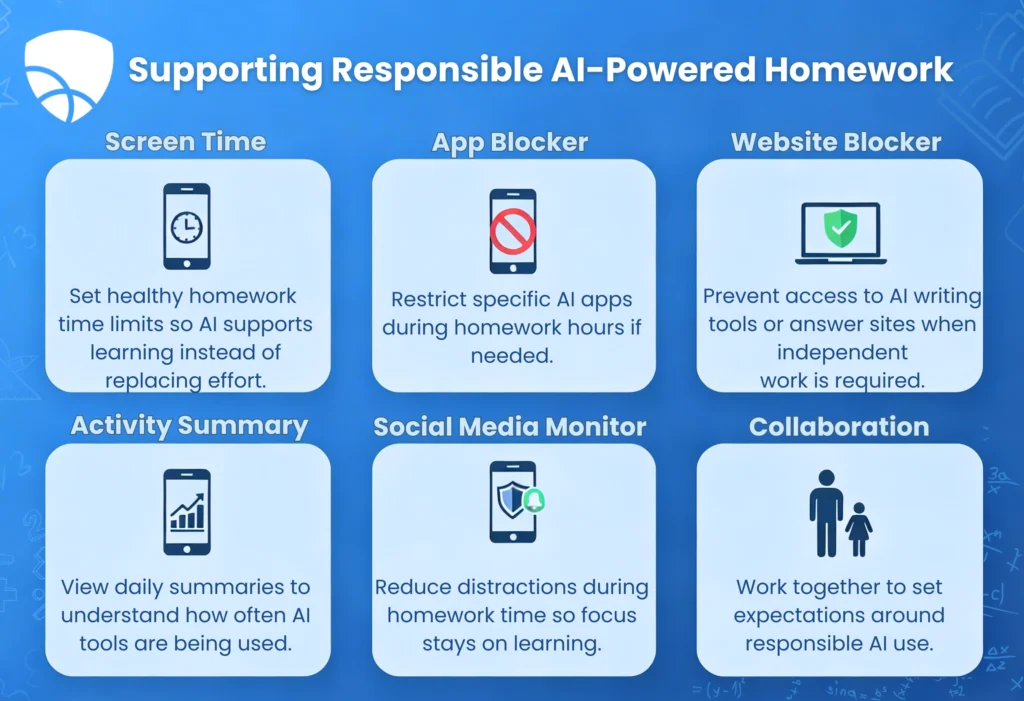
- Use Tools Like Mobicip to Assist in the Online Journey: Apps like Mobicip enable parents to ensure their children are using digital platforms responsibly through features like screen time limits, app blocking and scheduling, web content filtering, and activity reports. It allows for custom profiles according to age and cross-device coverage, providing a thorough but flexible approach to online safety. Mobicip’sblog also hosts a variety of articles on digital safety, providing parents with an up-to-date review of the things they need to know.
More Guidance
To better understand how AI can be used responsibly in education, it is helpful to hear from experts working directly in the field. In the video below, Anitha Swaminathan, VP of Marketing and Digital Safety Advocate at Mobicip and John Zoltner, CEO and Founder of AIChildSafety.org, discuss how schools and families can approach AI safely and responsibly.
In the conversation, John shares practical insights for parents and educators, including:
- How AI can support K–12 learning without harming student well-being
- Why schools need clear policies for both students and teachers
- Why banning AI tools outright may create a “cat-and-mouse” situation
- How guided AI use can teach responsibility while preserving critical thinking
- Why teachers should set clear rules for AI use in each class or assignment
This discussion shows how educators can incorporate AI into education to support learning rather than replace it.
Conclusion
It is unlikely that AI is going away anytime soon. The technology is now a common part of several aspects of children’s daily life – including academics. The question is how students can use these tools responsibly without harming their educational progress. Parents and educators can ensure this through active involvement.
Here, the establishment of healthy boundaries and open communication are important. Children must understand that technology should strengthen and augment their own thinking. Parents and educators must take a sympathetic approach that recognizes the pressures of school and the academic struggles students face. With moderation, care, and precise incorporation, AI-powered homework can support learning rather than substitute it.
FAQ
Is AI-powered homework considered cheating?
Not always. It depends on how the AI software in question is used. A student asking AI to generate whole answers and submitting it as their own work? That would probably constitute cheating, yes. A student using AI to help brainstorm ideas, clarify concepts, or practice problems? Probably not. It’s useful here to review the specific policies schools and teachers may have on AI use to understand the degree to which AI use is permissible in that specific institution and act accordingly.
Does AI-powered homework hurt critical thinking skills?
Again, it depends on how it is used. Blindly using AI to generate answers, including essays or math solutions, can weaken critical thinking skills. However, it can be useful when it helps students learn concepts and work through problems. Tools like Khanmigo, for example, are often rated highly and recommended to parents as helpful and educational.
At What Age Should Kids Use AI-Powered Homework Tools?
There is no hard-and-fast rule about when children should start using these tools. Younger children should avoid them or use them only under close supervision while learning foundational skills.
Older students may use these tools more often, albeit with clear boundaries in place.
How Do I Teach My Child to Use AI-Powered Homework Responsibly?
By explaining the purpose of various academic activities and setting clear boundaries with regard to AI-powered homework tools. Outlining specific tasks that children can use these tools for, such as brainstorming, clarification, and practice is also important as are open conversations about children’s academics and things they may be struggling with.
How Can Parents Monitor AI-Powered Homework Use?
Through apps like Mobicip, parents can set reasonable screen-time and app restrictions as well as review device activity. They should also discuss schoolwork regularly and ask children to explain what they are learning.